The letters in the title do not stand for a secret society or club; rather, they represent the four major constructs of creative thinking: fluency, flexibility, originality and elaboration. While the first three are needed to develop a solid and unique design, the latter, elaboration, is often shorted by highly creative individuals who are eager to move on quickly to the next great idea. The opposite can also be true if that creative is a perfectionist. The individual may find it difficult to move on because the piece is never just right.
Elaboration is the noun form of elaborate, which Webster (1995) defines as “planned or done with careful attention to numerous details or parts” . . . The application of the term elaboration to a discussion of creativity suggests that an idea has been embellished, developed, polished, or enhanced. (Meador, Creative Thinking and Problem Solving in Young Learners, Libraries Unlimited/Teacher Ideas Press (Available at Amazon.com)
Elaboration requires scrutiny of the original idea and, just as a writer adds adjectives to a sentence to make it stronger, a jewelry designer may add more detail to the basic piece with stones or wire work. In the picture examples, one photo shows elaboration of the original wave necklace that I started making a couple of years ago which is shown in the other photo. 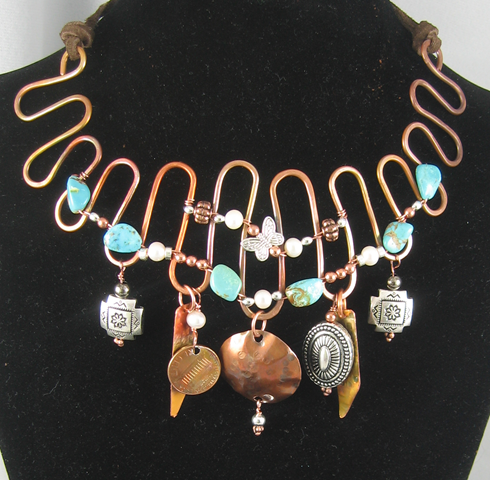 These look like very different necklaces and while one person may prefer the original, another may like the elaborated piece.
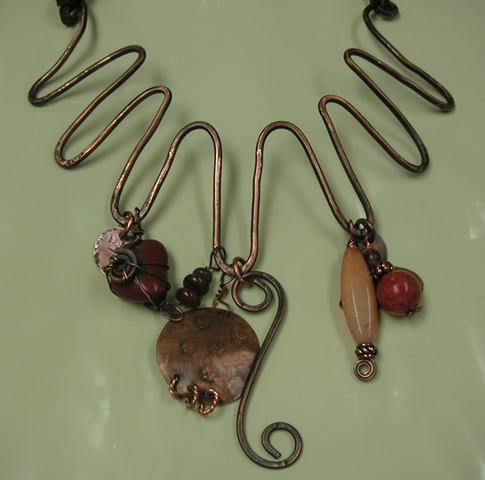
The point is not to make a judgment regarding which piece is the “best”, but rather to use elaboration to vary a piece so that a basic design gets plenty of mileage. I find it easier to elaborate upon an idea than to develop a totally new one.
While my definition of elaboration above written years ago is sound, I’m now using the elaboration step in creative thinking for a second purpose. It’s possible that a design can be overdone and have too much embellishment. I want to use the creative process to also determine if something should be removed or made smaller in a design. Creativity gurus would cringe at my use of the word for this, but we all know that sometimes “less is more”.
The final picture in this blog entry is of a basic bracelet. I worked through fluency, flexibility and originality to get to this point. Now, as I consider elaboration, I don’t know if it is better left alone or if it needs some detail. 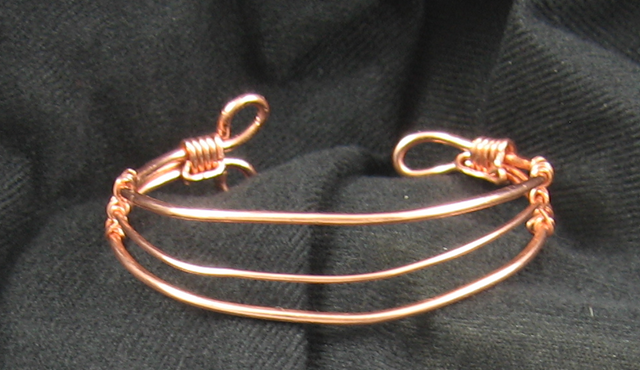 I’ll be playing with this design for a while. Currently, I believe the answer is YES and NO regarding detail. Some people will like the simplicity of the piece while others will find it uninteresting. Through elaboration, perhaps I can made something for both tastes.